Reviewing the REM
A month-late opening weekend review
December 22, 2025
Imagine living in a city that can’t build public transit. Could not be me.
The REM, Montreal’s new urban metro system, has officially opened! This miraculous line connects downtown Montreal to the northern island and the suburbs in Deux-Montagnes and Laval. It’s a really ambitious public transit project in Canada which got built to spec, basically on time, and basically on budget. Exploring how this happened—and if we can do it again—is critical for the success of future Canadian transit projects.
But I don’t just want to lore-dump on you. I thought I’d spice up this municipal infrastructure analysis with my very own REM opening weekend trip report! I rode up and down the entire new branch and stopped at every single new station to celebrate the big day. I don’t just want this to be a history lesson, I want to make you really feel like you’re riding the REM with me.
Allons-y!
❦
My journey began with the long trek out of my warm bed into the shower at 8 in the morning. Why so early? Well, for the special inauguration celebrations, they were only running trains from 9am-6pm, and I wanted to complete my journey in time to start writing about it at the Montreal Socratica, which runs from noon to 3-ish. I worried if I left after 3, I could have gotten trapped forever in Laval, never to be seen again.
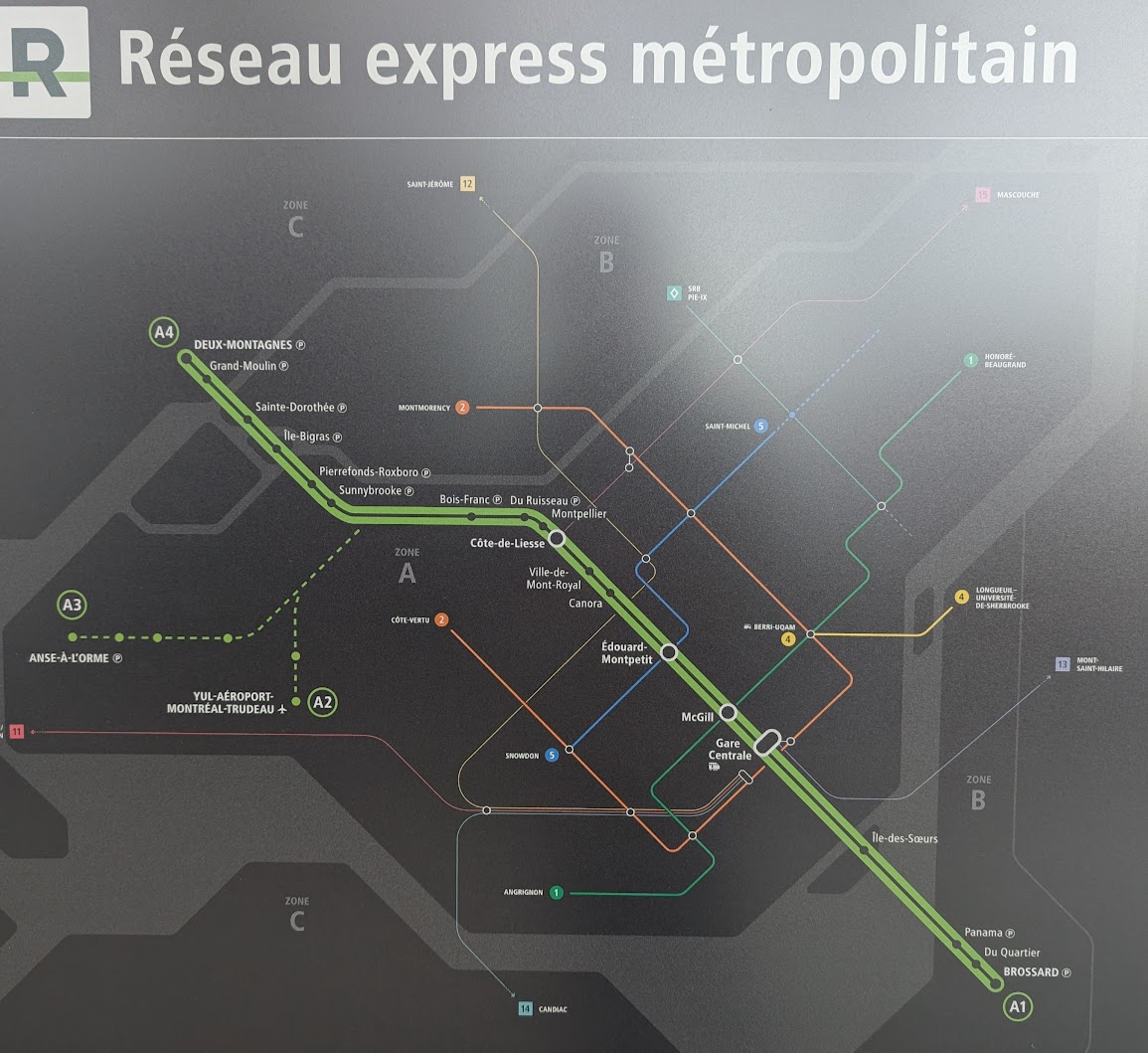
I began my journey at the newly opened McGill stop, conveniently located inside the existing McGill Metro. This is an important stop because it connects directly to the Metro’s Green Line. In fact, with the new branch open, the REM now has direct connections with the three major Montreal subway lines (Orange at Gare Central, Green at McGill, and Blue at Édouard-Montpetit).
This kind of coordination is not only convenient for riders, but also probably a necessity to avoid turning whichever station does have the connection into a giant choke-point. Consider how GO’s busiest line, Lakeshore West, only has one direct connection to the TTC at Union Station.1 No matter where you’re going, you need to get off at Union and then find a transfer.
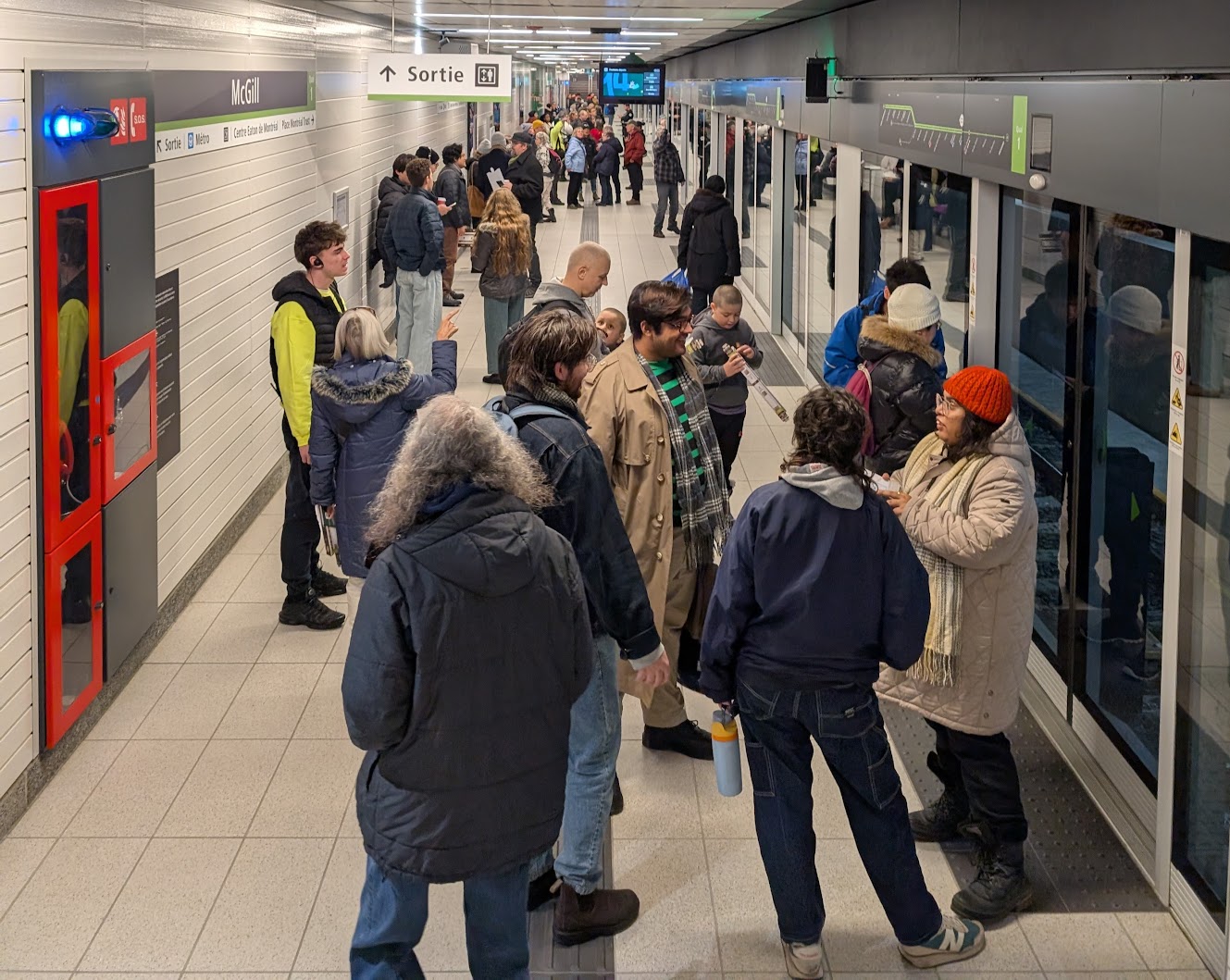
Of course, this isn’t a coincidence. The REM is under the purview of the ARTM,2 which is essentially the Montreal-area Metrolinx—an amalgamation of regional transit groups that can now plan for the long-term future of the entire region into account, as well as do helpful things like integrate fares between networks and build shared station infrastructure. The upside, in theory, is a smoother experience for the rider, no matter how many systems you need to hop, and thankfully the ARTM has been able to broadly deliver on this.3
But I’m getting off track (exactly the opposite of what you want from your transit)! The first thing that happened when I arrived at the station was I noticed all the staff, dressed sharply in REM-branded toques and crewnecks, waiting to greet me with a friendly bonjour. They passed me an opening-day passport which had empty pages for staff at each station to stamp, a really cute concept. They also offered me some piece of cardboard which looked almost like a big ticket, but I thought it would be too annoying to carry around so I passed and entered the main metro waiting area.
A lot of the REM’s best modern touches are comfort features in the platform itself. The most immediately obvious ones are the Platform Screen Doors, sliding doors which separate the waiting riders from the track, only opening when the train actually arrives. These are mainly a feature for rider safety, but an underrated benefit is that the non-underground stations later down the line can be in buildings which are completely climate-controlled with no exposure to the frigid Montreal winters. And besides keeping people safe from falling on the tracks, it also keeps the automated system moving quickly without needing to account for people or objects in the way of the train.
Oh yeah, the REM is fully automated, meaning there’s no drivers in the train itself. This is a cool technological advancement rolling out to more and more systems around the world—although it takes a bit of a sinister undertone in the wake of various STM labour strikes earlier this winter. Despite this, there are clear upsides for the operator and user: more space in the train, reduced risk of accidents, and the ability to keep trains moving faster and more flexibly.
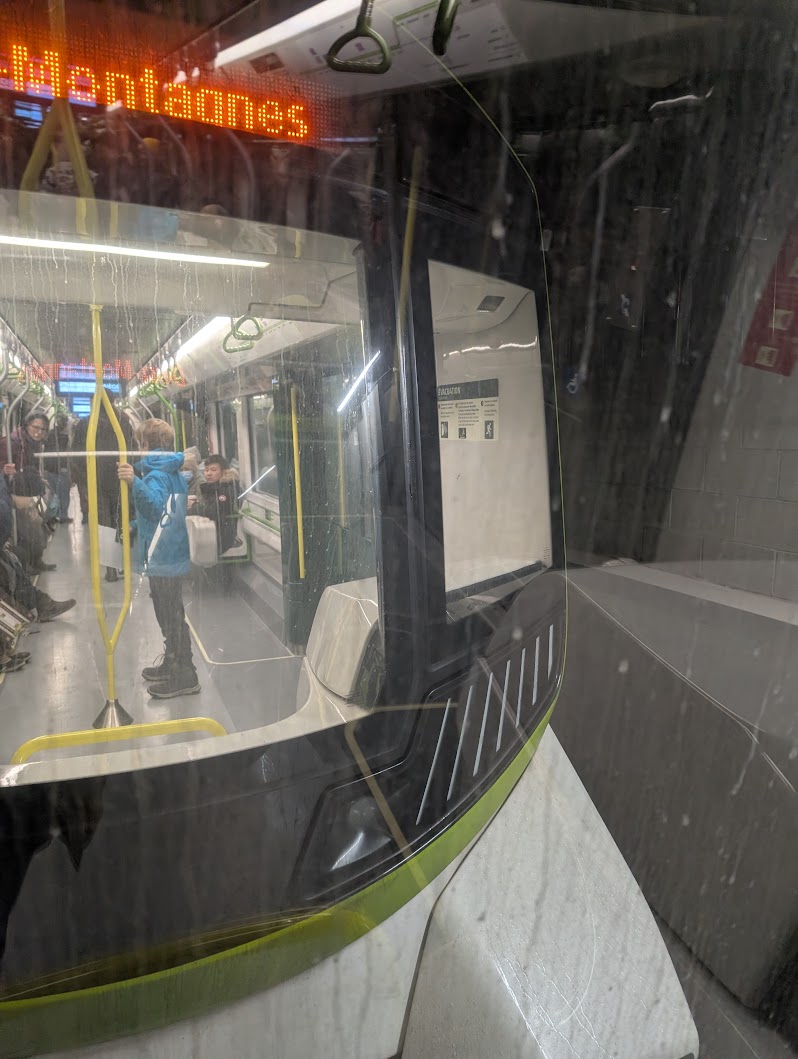
Speaking of moving fast, it was only a few minutes before my first train arrived. These things were really quiet, even compared to the relatively quiet regular Metro service we have here (although that probably had something to do with the screen doors). I loaded in near the front and took stock of my surroundings, including glancing up at the front windows.
An aesthetic benefit of automation is that the front and back of the train can be full glass windows, giving you an excellent view of the city you’re speeding towards. Every time I saw a train pull in, there were at least a half-dozen kids crowded at the front windows with their face against the glass, watching the world speed by. I can imagine what a great first impression this could make to first-time visitors to the city, especially when the extension to YUL Montreal-Trudeau Airport is finished.4
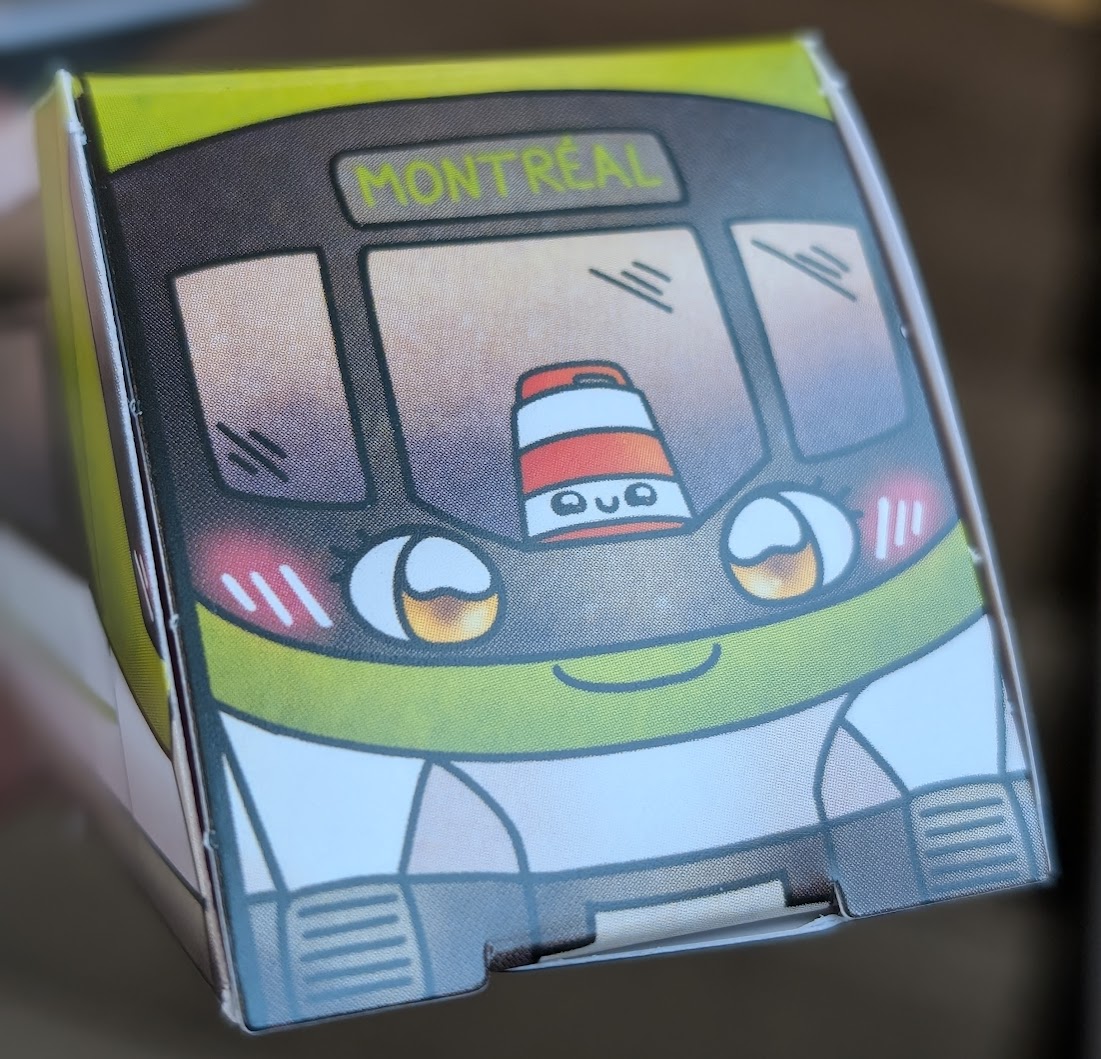
While I was watching the kids on the train, I noticed them holding something interesting. It was a long cardboard model of the REM train itself! It was so adorable, and I instantly realized ohh, THAT’S what they were trying to give me when I got my passport, and I started kicking myself when I realized I had turned it down. Fortunately for me, every station I stopped at had literally hundreds more to give out, so I got my own little REM-chan soon enough.
The actual ride itself was uniformly smooth and fast. It feels a lot like being on the regular subway—it even has a similar sounding announcer voice who politely informs you about the prochaine station.5 A full trip from McGill to the line’s terminus in Deux-Montagnes will take you about half an hour (unless you’re stopping at every station to look around like I was).
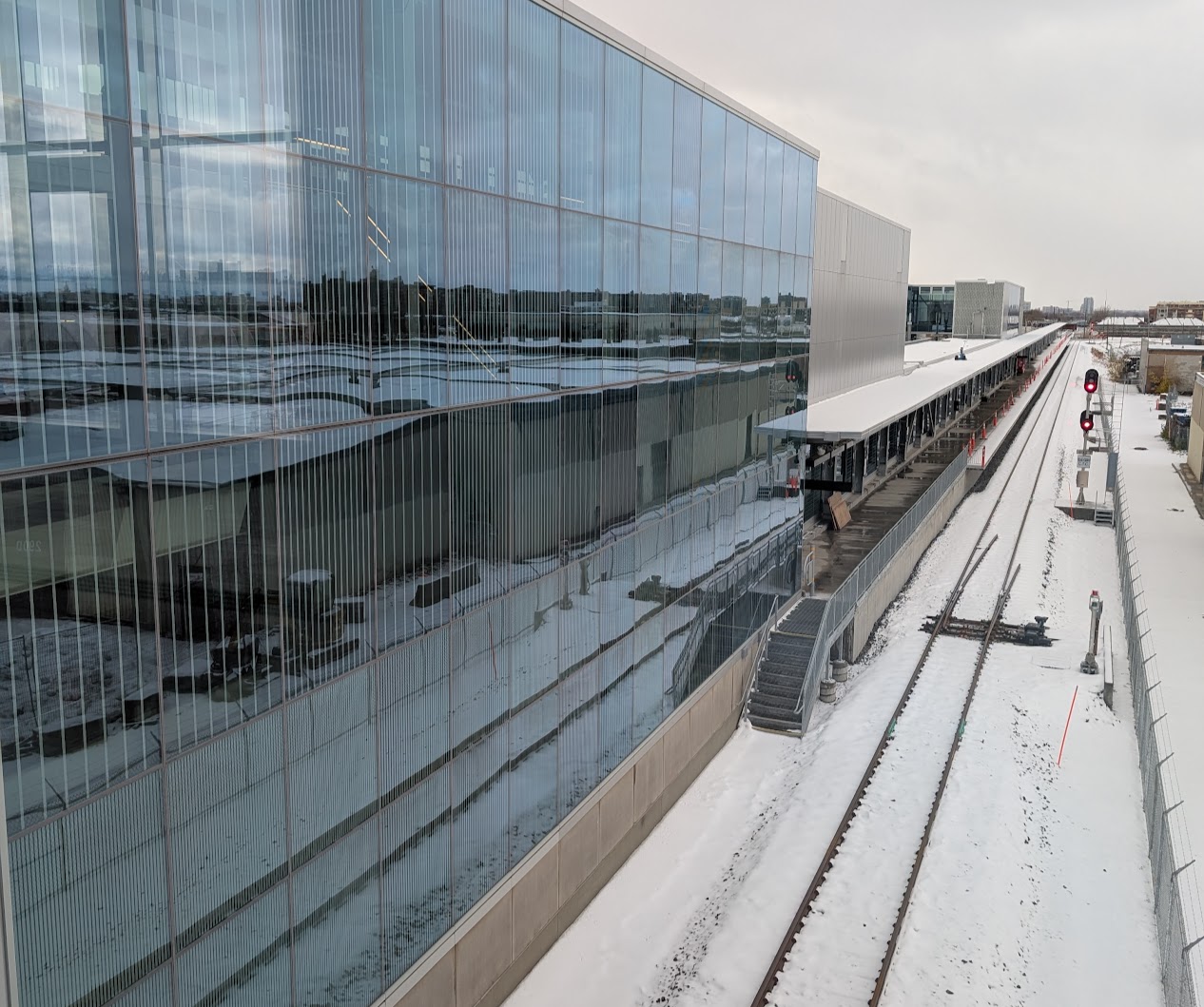
The non-underground, non-metro connection stations all have a similar look. They’re all large, fully enclosed buildings. They’re clean, sleek, and modern-looking. The platform itself is usually elevated a storey above the ground, with large staircases and elevators to take you up. The only roof in the building is the one up on the higher platform level, which alongside the full-body glass walls helps make the stations feel very spacious and not claustrophobic, which is something I appreciate about most of the metro stations in the city.
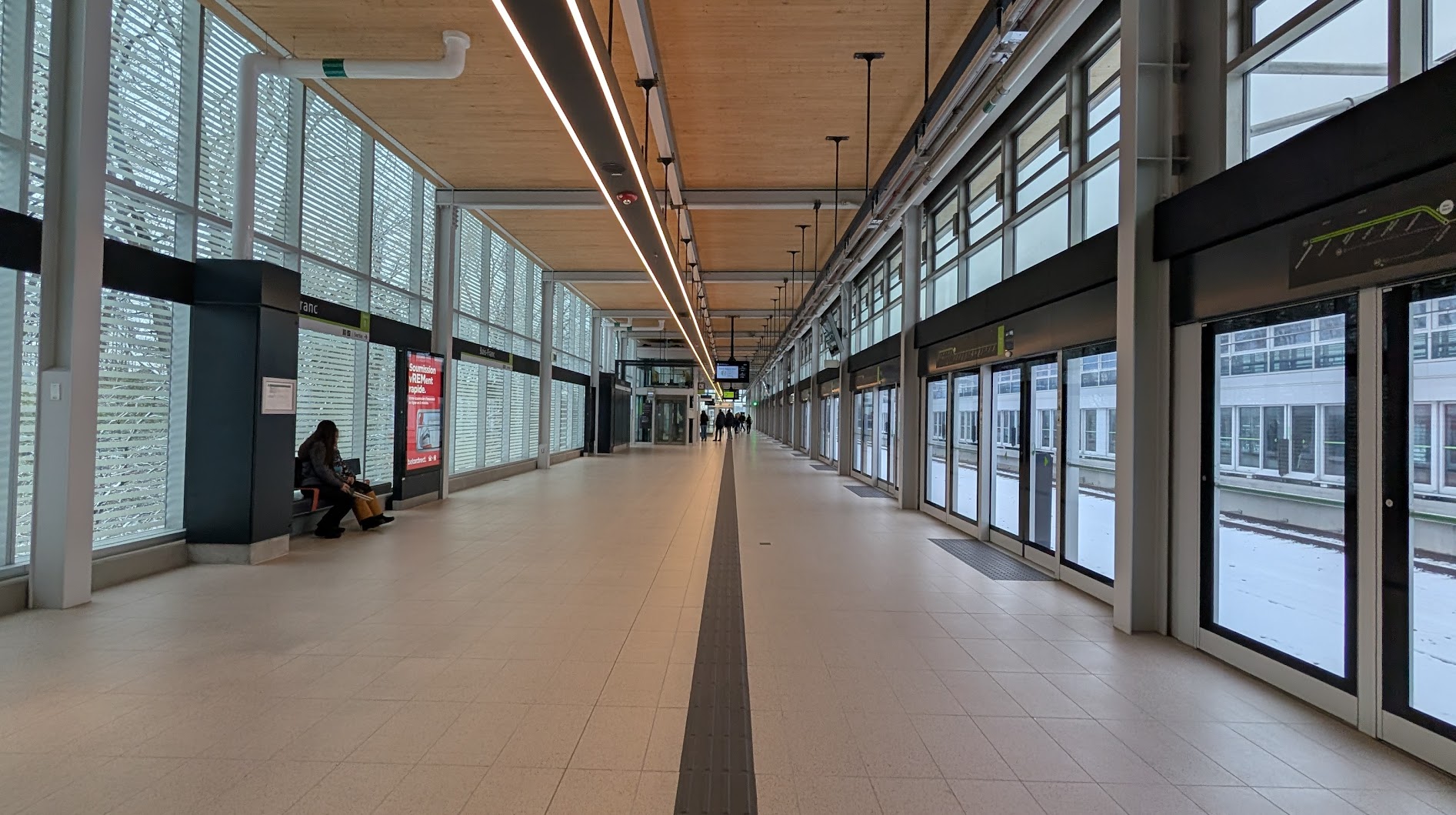
There is one disappointment I have about the stations, though, and that’s that they all look extremely similar. Each Metro station in Montreal kind of has its own thing going on, with different styles of tiling, big murals visible from the platform, different shapes and layouts, etc. It helps make each station feel like it has a unique identity, and it’s a shame the REM didn’t follow this trend of unique architecture.
A related problem I may have had is the lack of art in the stations, another key element of the Montreal Metro I was very impressed by during my first visit to the city. I say may have had because despite me only seeing art in one station I visited (Édouard-Montpetit, the final one on my way back to McGill), apparently there actually was more art on the route that I either missed or wasn’t built yet, so it may just be a skill issue on my part.6

The stations are in interesting spots, often EXTREMELY close to suburban housing developments—to the point where I could probably read the lips of the people living in some of the houses nearby. They must have really squeezed these stations into any gap they could. I don’t know the bus situation in this area very well, but as I understand the ARTM has done some rejigging to make getting to the REM stations by bus pretty easy, which should help get cars out of the road in the suburbs.
The inauguration festivities at each station were relatively humble, but I still had a fun time getting the stamps in my little passport for each station I visited. I was initially unsure if I was going to get them all or not, but I decided eventually that I was having enough fun exploring the stations and their surroundings that I did see them all.
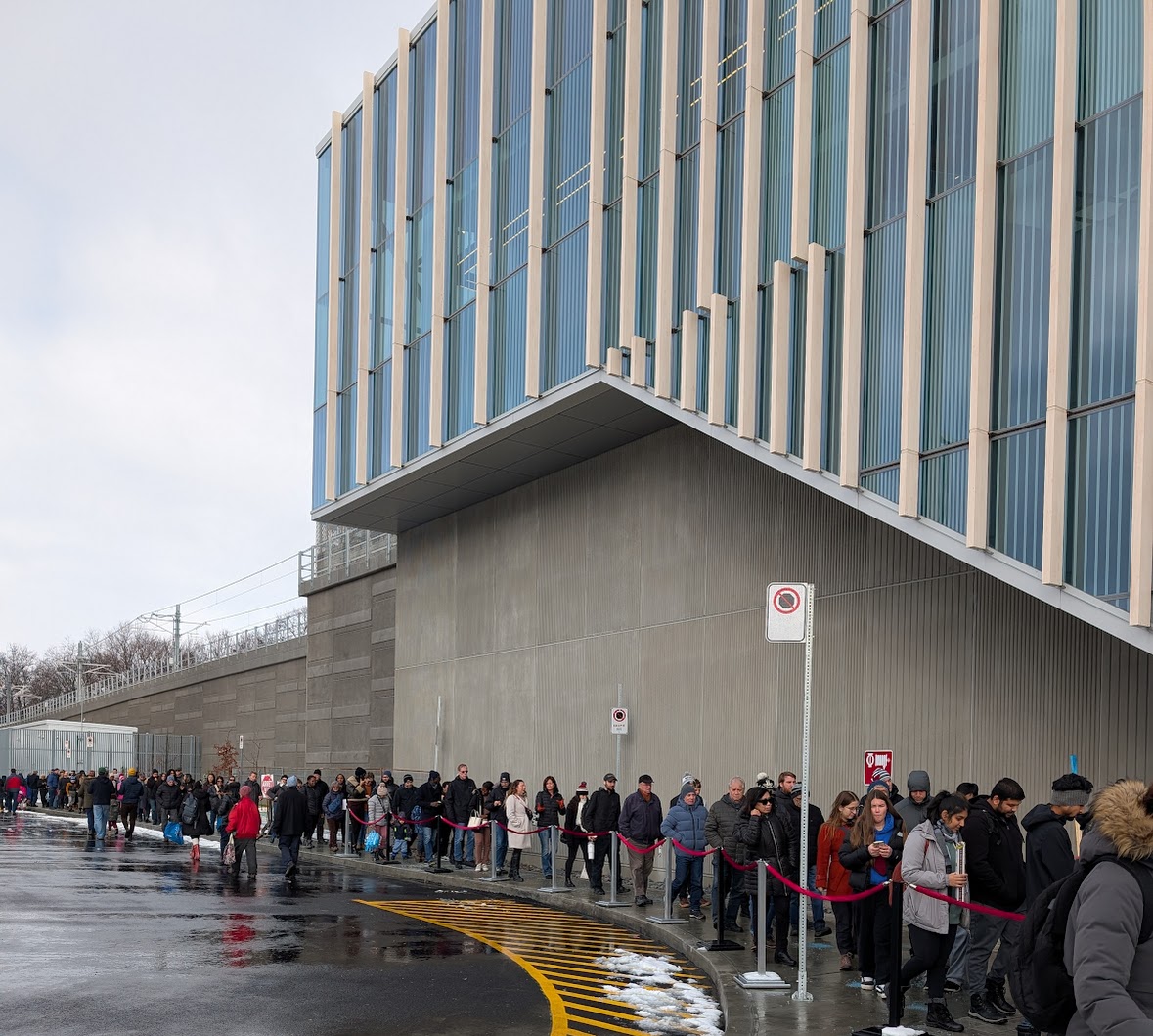
After getting some free hot chocolate and REM-green muffins at the end of the line, I took it all the way back. I’m glad I went early because it really started filling up around noon—by the time I got back to McGill around 12:45 there was a massive line to enter the Deux-Montagnes direction, even with trains every 10 minutes.
Oh yeah, did I mention that trains run every 10 minutes, and as quickly as every 5 minutes during rush hour? Man, the REM is cool.
❦
So what will the long-term future and impact of the REM be? Much of that depends on how the system evolves and shapes up in the future, but there are already some lessons we can learn. Despite some delays and teething issues, it’s hard to say the REM hasn’t been a success.
From a purely cost perspective, the REM in its totality is currently projected to cost about C$8 billion, or ~$140 million per kilometre for 67 kilometres of rail. This sounds like a lot of money—and it is—but it’s also orders of magnitude cheaper than similar projects across North America.
For example, Silicon Valley’s Berryessa BART extension cost C$3.23 billion for 16km (C$201M/km). New York’s Second Avenue Subway Extension is expected to cost C$8.41 billion for 2.4km (C$3.5B/km). And not to kick a dead horse, but the long-suffering Eglinton Line has cost $12 billion for 19km of rail—$631 million per kilometre for a plain-old above-ground light rail!7
Some of this has to do with the specific type of project: much of it is in suburban Montreal where they don’t need to dig underground, and they got to use an existing tunnel under Mont Royal for the metro-adjacent parts. It was built along freeways and land the city already owned and didn’t need to spend money for. These cost-cutting measures aren't always an option.
But some of it is also to do with the unique funding structure. It was developed as a Private Public Partnership (P3), where a corporation helps fund a public infrastructure project in exchange for partial ownership. P3s are attractive to governments not only because they require less taxpayer money be spent, but also because of a neoliberal belief that private entities are inherently more efficient than government, and that public services would be therefore better when outsourced to corporations under competitive pressure from the free market. This belief has a… let’s say, mixed track record when it encounters reality.
The most notorious example for Ontarians is the 407 toll highway, built by the provincial government and then sold to a private consortium under the belief that they could use the sale to pay down Ontario’s debts, and that market forces would keep tolls low. It did not, and toll prices have risen almost every year since, with all that money going to private investors.
Given how badly that went, it’s justified to be a little suspicious of the fact that the REM is fully owned by the CDPQ, Quebec’s biggest pension plan. But the devil is always in the details, and while we need to wait and see how it turns out, there’s reason to be optimistic this could go better than the 407.
The biggest difference is that the CDPQ is getting paid a flat, pre-defined rate per customer per kilometre by the ARTM, who actually collects the fares. This means that if the CDPQ wants to get more money from their asset, the best way to do it is to increase ridership, not start gouging existing customers who have no other options.
Another reason is that, while the governments of Quebec and Canada did put in money into the REM, all overrun costs are paid by the CDPQ. Public funders like Metrolinx are often motivated more by fear of embarrassment rather than fear of waste, so they’ll often allocate huge amounts of time and money upfront to avoid the PR hit of needing to ask for more of either.
But what seems to happen (at least in Ontario) is that the work simply fills the budget allocated for it, and they need to extend anyways, so they end up paying more than necessary twice. It’s better to have a project budgeted for $6 billion that doubles to $12 billion, than a $15 billion project delivered as expected.
It’s not all sacrifices from the CDPQ, though. The government played a major role in clearing the way for the REM, passing all sorts of special exceptions to speed along development, but also by not taking any participation in the design phase, giving the CDPQ maximum options and full autonomy to get into the weeds.
A counterexample to this style is, sadly, GO Expansion, the ambitious plan to give GO trains REM-like service and frequency which collapsed recently because of disagreements between Metrolinx and Deutsche Bahn, the private operator that Metrolinx hired and then seemingly micromanaged into quitting the project entirely.8

The REM certainly isn’t flawless, and the cancellation of REM de l’Est is a discouraging sign for this model being replicated in the future. But we have a lot of public infrastructure we need to build in Canada, and right now the REM is our biggest success story in at least a decade. For the sake of future generations—and more importantly, the Toronto-Montreal high speed rail project that God help me I WILL live to ride—we need to take every lesson we can from what went so right here.
In conclusion: c’est bon.
❦
Sources:
- https://transitcenter.org/on-track-for-success-decoding-montreals-rem-model-for-efficient-transit-projects-in-the-u-s/
- https://www.lexpert.ca/news/legal-faq/public-private-partnerships-in-canada/390366
- https://www.bloomberg.com/news/articles/2023-10-30/how-montreal-s-new-rapid-transit-line-saved-millions-per-mile
Also, all photos in this article were taken by me!
Footnotes
-
This is something that is getting fixed with the upcoming Ontario Line, thankfully, using a new direct connection at Exhibition GO, but that won’t be open until the 2030s at the earliest. ↩
-
Autorité Régionale de Transport Métropolitain. Apparently the M doesn’t stand for Montreal. Who knew? ↩
-
I have a half-finished article in the works trying to figure out why the ARTM is working out great but Metrolinx isn’t, so stay tuned for that eventually. ↩
-
It’s really weird there wasn’t a rail line from the airport to downtown until the REM, and even then that line isn’t actually ready yet—that sub-line isn’t meant to open until 2027. ↩
-
I initially thought this was the same person, but it turns out that the REM voice actress is the daughter of the Metro voice actress! https://rem.info/en/news/voice ↩
-
The website has some of these as CGI renders instead of pictures, so I can’t tell if these are built now or only under construction, but also some of the REM website hasn’t been updated with the info that the Deux-Montagnes line is open now so maybe it wouldn’t even be helpful if they did specify. https://rem.info/en/unir ↩
-
Every executive at Metrolinx should be in jail. ↩
-
Read this to instantly become furious: https://www.thetrillium.ca/news/the-trillium-investigations/how-metrolinxs-plan-to-deliver-european-style-train-service-went-off-the-rails-10786705 ↩
Recommended posts
Get new posts delivered to your inbox via Substack.
Prefer RSS? Subscribe via RSS feed.